In October, Runxun introduced a server with eight GPUs and SpacemiT announced a platform with a RISC-V processor. GMKtec and Minisforum desktops with 192 GB of shared memory illustrate another approach to local AI: compact systems alongside multi-GPU rack machines. These hardware classes have different requirements for placement, expansion and model-serving software.
The primary announcements reviewed do not establish Russian prices, supply or service for these systems. The GMKtec and Minisforum devices predate October; they are included here for a technical comparison with the new server platforms.
We examined developments between 8 October and 8 November 2026. This article covers two server platforms announced during that period and two compact computers for comparison. Local inference means running a trained model on your own computer or server: it receives a request, processes it and returns an answer without calling an external cloud model. An internal search service, for example, could pass retrieved passages from technical documentation to the model and return an answer to an employee. That is a possible application, rather than a tested outcome on these four machines. We conducted no load tests ourselves.
Runxun R500: eight GPUs and preconfigured software
Runxun announced the R500 on 13 October. This 6U rack server has eight NVIDIA RTX PRO 5500 Blackwell GPUs and targets enterprise deployments. The manufacturer lists Qwen and Llama among supported model families and internal knowledge bases and programming among its uses. It says vLLM, Ollama and SGLang inference software is preconfigured, alongside its own XunOS and MaxControl software environment.
Hardware and inference software are part of one offer. In a separate build, the customer or integrator selects compatible versions of that software; Runxun says it has already completed the initial setup. The published announcement provides no reproducible table specifying the exact model, quantization, context length and number of concurrent requests.
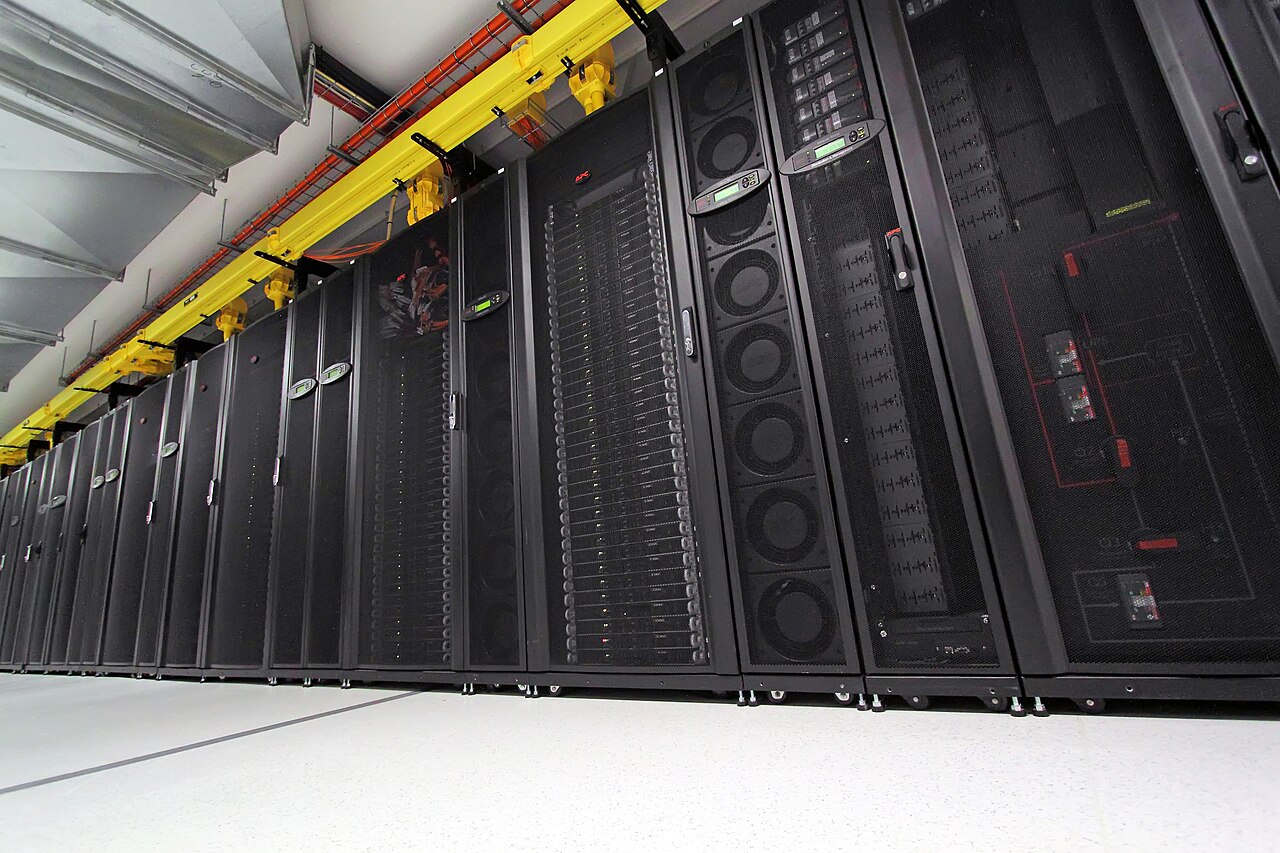
The standard R500 configuration includes two Xeon Gold 6530 processors, 1 TB of DDR5 ECC RDIMM memory, NVMe and SATA storage, a dual-port 100GbE network adapter and four 2,700 W power supplies. This is equipment for a rack and a prepared server room. Adding the power-supply ratings would misrepresent actual consumption: the manufacturer does not disclose measured power draw for the complete system or the redundancy arrangement here.
The memory figures need the same care. A terabyte of system RAM is different from a terabyte of GPU memory. Model selection depends on the memory available on each GPU and how the software distributes computation across the cards. The pages we examined did not provide enough information to responsibly promise a particular large model at a specified speed.
The R500 merits attention from a company with its own server room and deployment team. Its distinguishing feature in this selection is a multi-GPU node with reportedly preconfigured popular inference tools. For a Russian project, procurement remains a barrier: we found no public ruble price, confirmed Russian supplier or R500 service commitments. It can be considered for supplier discussions and a demonstration test; confirmed delivery to Russia remains unestablished.
SpacemiT G5201: a new architecture needs compatible software and accelerators
On 20 October, SpacemiT announced the V100 and three server platforms. The relevant system here is the G5201, an accelerated-computing platform designed for eight full-height, dual-slot cards. The company reports validation with Kunlunxin and other accelerators, support for remote direct memory access (RDMA), and a V100 processor based on RISC-V, an instruction set different from the x86 architecture common in Intel and AMD servers. The V100 has 46 cores, with dual-processor configurations supported.
The physical role of each component matters. The V100 is the server's CPU; the eight accelerators perform a separate role. The G5201 is a platform for which buyers select accelerators and software. Comparing its CPU core count with a language model's parameter count serves no useful purpose. The chosen cards, their memory and software support also determine which language-model workloads the system can handle.
For developers and integrators, the attraction is the opportunity to build RISC-V servers. An applied-AI customer needs the complete configuration to be ready for its chosen model. Linux support leaves separate work to establish whether an existing x86 package, accelerator driver and optimized inference kernel will run without porting. SpacemiT's release provides no G5201 results on specific large language models that would support comparison with the other machines in this article.
This announcement has a different purchasing horizon. It is relevant to platform evaluation, development and a joint project with a supplier. A buyer who needs a working internal assistant within the next quarter would need evidence that the whole configuration is ready. We could not confirm Russian pricing, availability or local service for the G5201. That procurement gap matters before performance discussions begin: the announcement alone does not establish an available commercial configuration.
GMKtec EVO-X5 Pro: a large memory pool in a desktop case
GMKtec's October news concerns the development of an existing product. Its 9 October announcement explicitly states that the EVO-X5 Pro launched globally on 28 September. The October event focused on commercial applications, management and connecting multiple nodes. It did not make the computer an October server launch.
The EVO-X5 Pro brings a large shared memory pool into a compact device. The manufacturer's specifications list a Ryzen AI Max+ PRO 495, Radeon 8065S graphics and 192 GB of soldered LPDDR5X-8533 memory. The memory cannot be upgraded after purchase. Other features include two 10 Gbps network ports, three M.2 storage slots and Linux/Ubuntu support alongside preinstalled Windows 11 Pro.
The CPU and GPU use shared memory that holds the model's weights, its numerical parameters. That is attractive to an individual developer, a research team or an internal-service pilot: heavier models become possible without assembling an eight-GPU rack system. RAM capacity alone does not determine concurrent user capacity; that depends on the chosen model's speed and the requests it receives.
On 29 October, GMKtec published its own results for the 320-billion-parameter GLM-5.3-Flash. Tokens are the pieces of text processed by a model. In a long-input test with 499,712 input tokens, the company reported generation at 28.23 tokens per second and a time to first token of 795.77 seconds. The latter is approximately 13 minutes and 16 seconds, by our calculation.
That is a consequential distinction when assessing usefulness: according to GMKtec, the system processed a very large input in this test, but the answer took substantial time to begin. These are internal results rather than independent measurements; they cannot be carried over to a different model, quantization or several parallel sessions. Faster input processing also does not imply the same increase in output-generation speed.
Minisforum MS-S1 MAX-P495: the same memory class, different expansion options
The MS-S1 MAX-P495 is included to compare compact systems; an October debut has not been established. Its official product page describes a Ryzen AI Max+ PRO 495, 192 GB of shared memory, up to 160 GB allocated to GPU memory, two 10 Gbps network ports and two M.2 storage slots. The full-length PCIe x16 slot is electrically PCIe 4.0 x4, an important distinction when choosing an expansion card.
The similar platform makes comparison especially practical. Ports, storage, service and delivery terms become useful points of differentiation. Computers with the same processor can perform differently because of cooling, power settings and software configuration. We have no comparable measurements of the two machines from our own testing.
Minisforum lists a sustained 120 W mode, a 160 W peak and a built-in 320 W power supply. These describe different things; they are not three estimates of a monthly electricity bill. Power consumption for a continuously running service needs measurement under its actual workload. Likewise, a desktop form factor can still involve substantial fan noise: placement depends on fans, airflow and acceptable sound levels.
What actually fits in 192 GB
Quantization reduces the precision used to store weights and the model's size, sometimes at a cost to quality. A claim of “320B locally” therefore leaves a key purchasing detail unanswered unless the weight format is specified.
One illustrative calculation: 320 billion parameters at 16 bits require about 640 GB for weights alone; at an ideal four bits, about 160 GB. These are decimal gigabytes and theoretical arithmetic, rather than the size of a particular file. Format overhead, operating-system memory, working buffers and context memory come on top. The vLLM documentation separately covers reducing the KV cache, the memory that stores intermediate attention data.
For a 70-billion-parameter model, the equivalent lower-bound calculation gives 140 GB at 16 bits or 35 GB at four bits. Speed, architecture support and long-context operation remain separate requirements. Fitting the weights resolves only part of the task.
The practical selection criterion is performance on the intended workload: for example, time to first token on a long document and subsequent generation speed with several requests. For compact AMD systems, the precise software build matters: llama.cpp supports multiple compute backends, including Vulkan and HIP. Support in the project still needs validation on the particular computer, driver and model.
Russian supply and the requirements of a working service
The primary Runxun, SpacemiT, GMKtec and Minisforum publications describe hardware and claimed capabilities. They do not establish Russian prices, availability of a particular configuration, delivery dates or local service terms. These sources cannot confirm a complete supply arrangement for a Russian project.
The technical differences are visible. The R500 combines eight GPUs in a rack server; the G5201 supplies a new CPU platform for assembling an accelerated node. The GMKtec and Minisforum desktops offer 192 GB of shared memory with different expansion options: GMKtec has three M.2 slots, while Minisforum has two and a PCIe x16 slot using four lanes.
Evaluating a working service starts with the chosen model and the requests it will handle. GMKtec’s published 13-minute wait for an answer to begin on a very long input shows how memory capacity and user expectations can diverge. Ports and storage slots help specify the hardware; speed and simultaneous employee use need testing on the particular software build.
The computer still needs to be connected to documents and a working interface. For internal knowledge-base search or an employee AI assistant, pommeDeTerre helps build these services and connect them to business systems. Local deployment of a chosen model on particular hardware is considered separately from purchasing the device.