FLUX 3 Image Klein combines image generation and editing: one model accepts text and up to ten pictures from which to assemble a new scene. In Black Forest Labs’ official example, a photograph of a dog becomes a print on a mug beside a window. The first picture supplies the object and setting; the second supplies the image to transfer.
Black Forest Labs released Klein on 15 October. The 5.6-billion-parameter model supports output up to 4K and bounding boxes for placing elements. Downloadable weights, inference code and a separate model that expands short requests into detailed scene descriptions are available. Local editing uses all these components: the generator’s size describes only part of the system.
What the compact model includes
The FLUX 3 Image Klein model card lists the image generator, Qwen3-VL-4B-Instruct text encoder and image autoencoder separately. The encoder converts a description into the numerical representation used by the generator. The autoencoder connects the internal representation to finished pixels. Before them, a prompt upsampler prepares a full description.
There are two main checkpoints. Base is intended for fine-tuning, research and LoRA training: adapters for a particular task or image collection. Distilled Klein is designed for everyday generation and editing; training has reduced the required sampling steps to 16. Documentation specifies 50 steps for Base. The distilled version does not use CFG, the additional control over the strength of text conditioning.
BFL also releases weights with reduced numerical precision. These formats reduce the data stored and transferred during computation. Support depends on the GPU and inference software. NVFP4 targets Blackwell hardware; INT8 builds are available for ComfyUI. Choosing a local configuration also involves the encoder, upsampler and input-image sizes.

Black Forest Labs. Official logo from the company brand kit.
Why another model expands the request
The generator receives a complete description rather than a short command. BFL’s Prompt Upsampler is a 9-billion-parameter vision-language model fine-tuned from Qwen3.5-9B. It accepts the request, references and optional coordinates, then describes composition, lighting, materials, colours and object positions.
Four system prompts cover generation, editing and their two bounding-box variants. For an edit, the upsampler examines the source images and describes what changes and what remains. Text intended to appear inside the image is retained verbatim in quotation marks. The upsampler outputs an English description; the user’s request can be in another language.
In BFL’s inference code, this stage is enabled by default. It can run separately and supply its finished caption to the generator when both models cannot fit on the GPU together. Another language model can replace the supplied upsampler using BFL’s system instructions.
References are resized before analysis: the limit for a single image is about one megapixel, and less for several. A small detail can receive an inaccurate verbal description before generation begins. The expanded prompt is therefore a separate processing output: it shows which visual characteristics the system passed on.
Two references: a dog printed on a mug
The official example collection first generates a white mug on a wooden table beside a window and a golden retriever on a sandy beach. Both pictures are then supplied with a request to print the dog from the second image onto the mug. The edit includes a published command, the initial random seed 23 and JSON containing the actual description received by the generator.
The example separates the references’ roles: one defines the scene to edit; the other provides the print’s content. The expanded description retains the mug’s position, handle, window and lighting. The repository also demonstrates adding coffee and a croissant, giving the dog a red bandana and turning an object into a desk figurine.
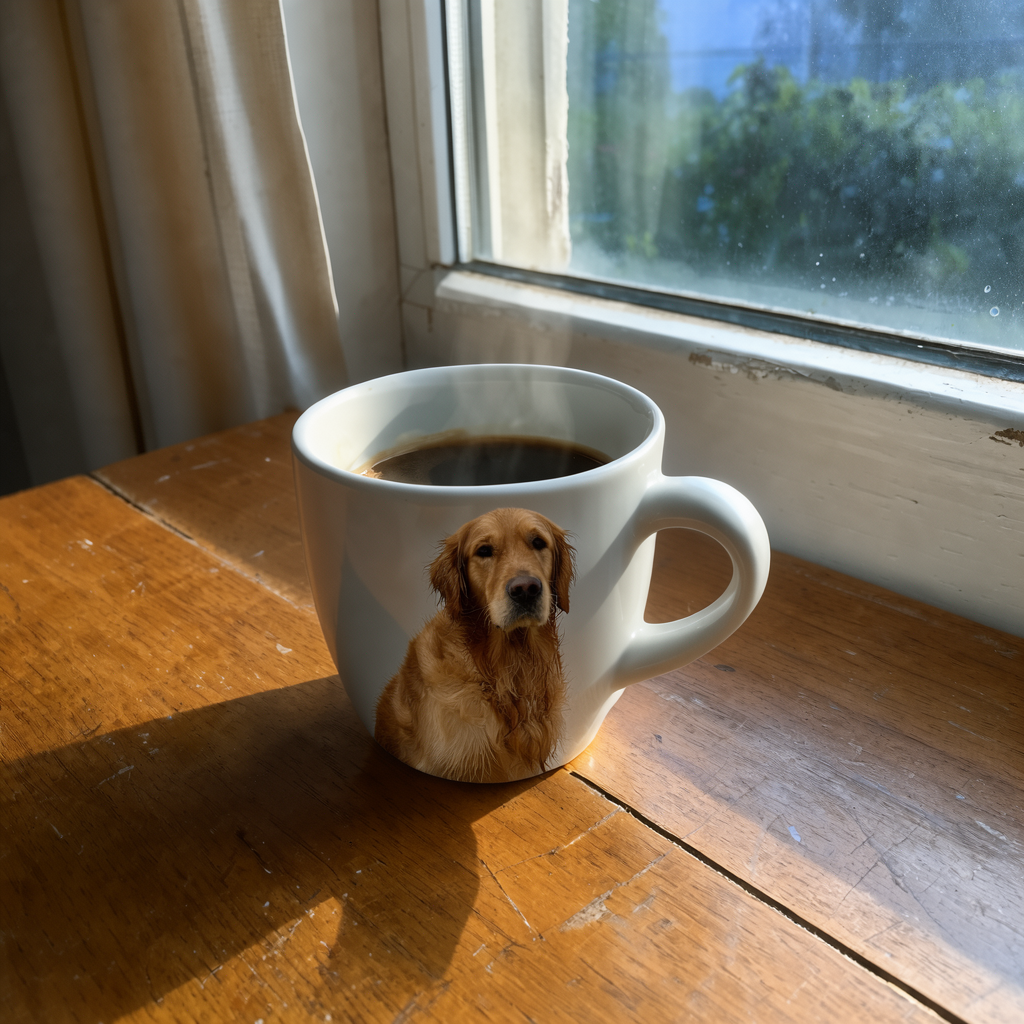
Black Forest Labs: the two-reference result. Source files, parameters and commands. Repository materials are Apache 2.0.
In the model’s prompting guidance, an edit is described as a complete scene with the change incorporated. A short request such as “make it blue” is first expanded into that description. For style, the developer recommends visual attributes: palette, stroke and texture. The text specifies both the new content and the original composition’s properties to preserve.
Bounding boxes and two coordinate formats
Layout annotations add object positions to the text. In BFL’s command-line interface, boxes.json contains rectangles ordered as top, left, bottom, right, with values from 0 to 1. The origin is the top-left corner. A [0, 0, 0.5, 0.5] box occupies the upper-left quarter at any resolution.
For the text passed to the model itself, BFL’s model card describes a 0–1000 grid. This is a different representation of the same relative positions. Each box has an identifier and description. Editing can specify a reference’s source region and a target position separately, connecting the transferred object to its new location.
The developers publish an example that adds a cactus beside the mug: the source image is supplied with an instruction and a box table. For generation from scratch, comparable annotations place hot-air balloons above a valley. In both cases the coordinates specify the object’s position and scale within the scene.
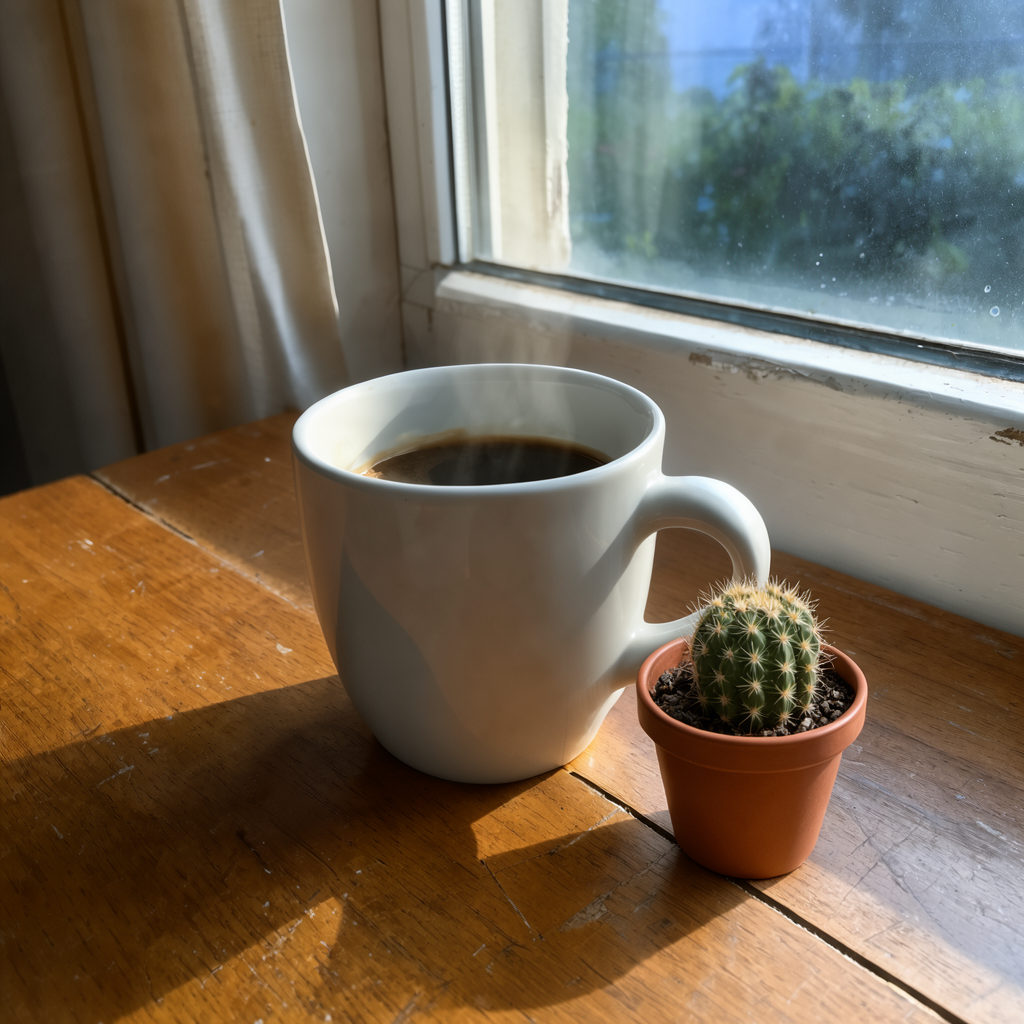
Black Forest Labs: a cactus added in the specified region. Source files and command, Apache 2.0.
BFL’s documented limitations leave the box as generation guidance: an object can extend beyond it, a small requested element may not appear, and an edit can affect neighbouring content. Rendered letters can also be distorted. These are properties of how the model produces images, even when coordinates are recorded precisely.
Local speed and licence conditions
The Klein release announcement includes NVIDIA measurements for the distilled INT8 model: a one-megapixel image takes about four seconds on an RTX 5090 and under nine seconds on an RTX 4070 through ComfyUI. The model uses 16 steps; the numbers describe GPU computation time. Queueing, networking and prompt upsampling belong to separate API-latency figures.
The same announcement reports that the INT8 build runs on RTX cards with 8 GB of VRAM. This describes a particular inference path with component-loading management. The separate upsampler and generator can run sequentially; increasing resolution and adding references change the workload.
The weights use the FLUX Kommunity License. It provides non-commercial use and a separate commercial-output exception for Qualifying Users: users with gross annualized revenue, including affiliates, below $5 million, subject to the remaining terms. The inference code and prompt upsampler are released separately under Apache 2.0.
The open inference code stores JSON beside each generated image: its expanded prompt, size, step count and initial random seed. It also records guidance, the strength of text conditioning used by Base; the distilled model operates without CFG. Together with the reference files, that record describes a specific edit: which object was transferred, where it was placed and the settings used to produce the picture.