In Z.ai’s release table, the Terminal-Bench 3.0 row reads 28.3 for GLM-5.3, 33.7 for Claude Fable 5 and 34.6 for GPT-5.6 Sol. For a developer assigning an agent a long terminal task rather than a code fragment, that row matters more than the “Built to Code” slogan used to introduce the model on August 14.
One row does not erase GLM’s progress. Z.ai says GLM-5.3 improved on GLM-5.2 by roughly 50 percent on its closed Z.ai Code Bench. The public comparison table supports a narrower claim: GLM is close to the strongest systems on some agentic tasks, but trails closed Anthropic and OpenAI models on several demanding coding rows.
Unless explicitly stated otherwise, every comparative number below comes from the vendor. We did not reproduce these runs independently, so this article separates the published result from the conclusion that result can actually support.
Progress that should not be dismissed
Z.ai describes GLM-5.3 as a post-training update to GLM-5.2. In its table, the score rises from 4.6 to 28.3 on Terminal-Bench 3.0, from 46.2 to 66.9 on DeepSWE v1.1, and from 19.4 to 42.5 on SWE-Marathon v1.1. Even with the source caveat, this is a substantial jump within one model family.
The release targets an agent that reads a repository, works in a terminal, runs tests and corrects its own mistakes—not autocomplete for a single function. In that setting, a score belongs to the whole system: model, agent harness, tools, turn limit, context policy and evaluator.
Where “caught up” stops
On Terminal-Bench 3.0, GLM trails the best listed result by 6.3 percentage points. On DeepSWE v1.1 the scores are 66.9, 69.7 and 72.7 for GLM, Claude and GPT respectively. On ProgramBench, GLM scores 19.0, Claude 33.0 and GPT 23.0.
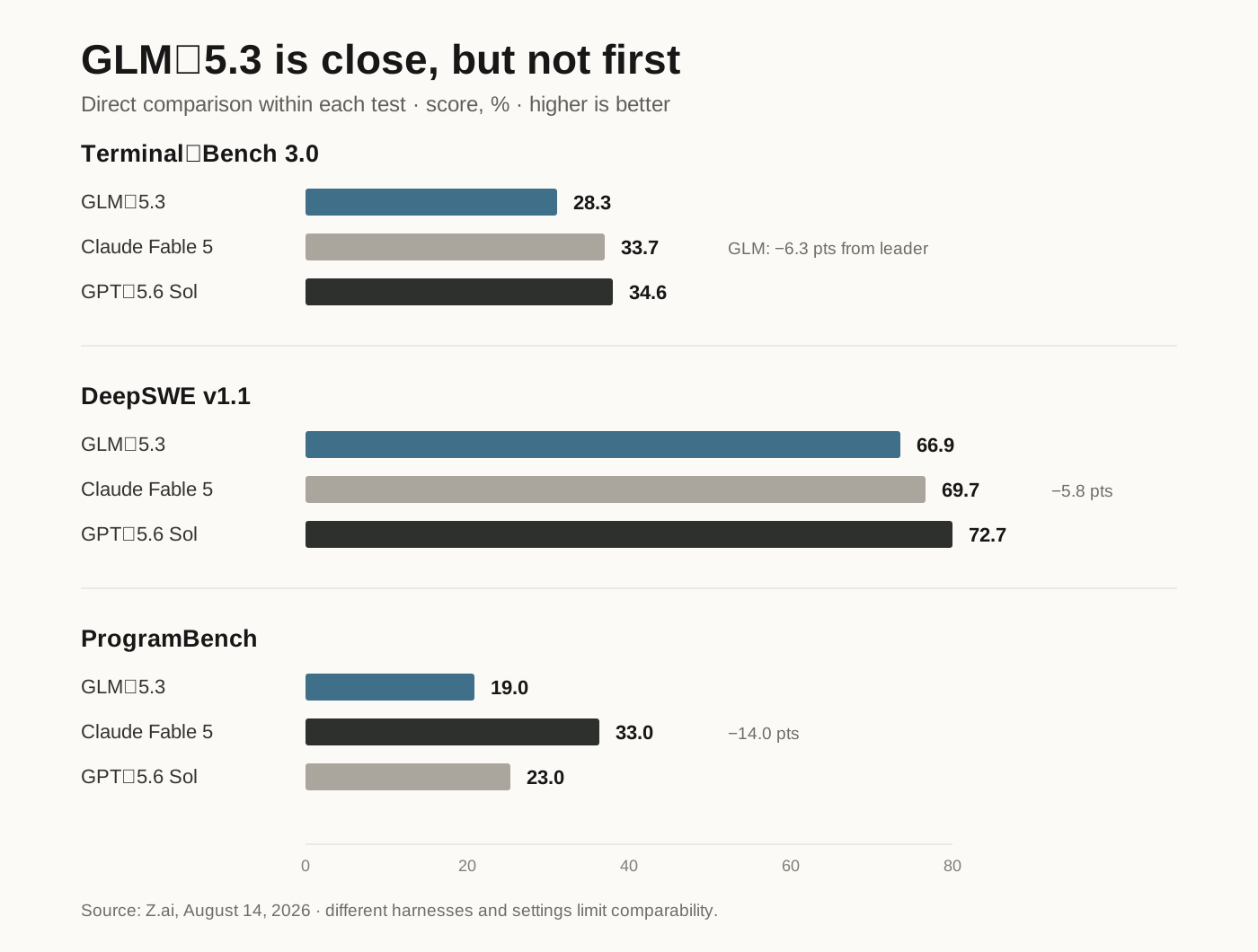
This is a narrow conclusion, not a universal ranking. On Terminal-Bench 2.1, GLM and GPT are separated by only 0.6 points; on SWE-Marathon v1.1 both are listed at 42.5. The leader changes with the task, and small gaps cannot be interpreted confidently without repeated runs.
Why the table is not a final verdict
Z.ai itself describes different run settings. Terminal-Bench 3.0 was run in Claude Code at maximum effort, with three rollouts per task, a 600-turn ceiling and a timeout of up to ten hours. DeepSWE used another harness and parameters, while Z.ai Code Bench remains a closed internal set.
The table is useful because it measures agentic behavior rather than isolated code generation. A broader conclusion would still require a shared open protocol, the same harness version, repeated runs and an independent replication.
External commentary is not yet independent verification
AI Agents GPT and VentureBeat reviewed the release independently, but both relied on Z.ai’s table. Both noted the limits of the closed Code Bench and the lack of evidence for declaring an outright winner. That is useful interpretation of primary evidence, not a new experiment.
An early community SlopCodeBench run placed GLM near Fable and Sol on one set, but the models ran in different harnesses and separate sessions. The small sample proves neither leadership nor systematic inferiority; it strengthens the case for a controlled internal test.
Why an expert review cannot replace your repository
A reviewer may see another model version, a convenient task, an empty repository and a different token budget. A recent preprint on automated code review did not test GLM-5.3, but it found a methodologically important pattern: performance changed sharply between synthetic mutations and real pull requests, while diff size was a strong factor.
For a team, “did it write working code?” is only the first filter. The next questions are whether it found the right module, preserved the API contract, avoided gaming a test, left a reviewable diff and refrained from presenting a hypothesis as completed work.
Cheaper does not yet mean better value
Z.ai reports that at maximum effort GLM-5.3 solves 34.5 percent of its closed Code Bench tasks using roughly 75,000 output tokens; the same material lists 39.5 percent for Claude Fable 5. Without open tasks and a shared workflow, this is a vendor-reported characteristic, not the cost of an accepted production change.
At publication, important product facts were still unsettled: an external pay-as-you-go price was not stated in the reviewed material, and Z.ai delayed weight publication by about two weeks, citing additional cyber-capability checks. Real economics must include retries and engineering time spent repairing the result.
How to test GLM-5.3 in your team
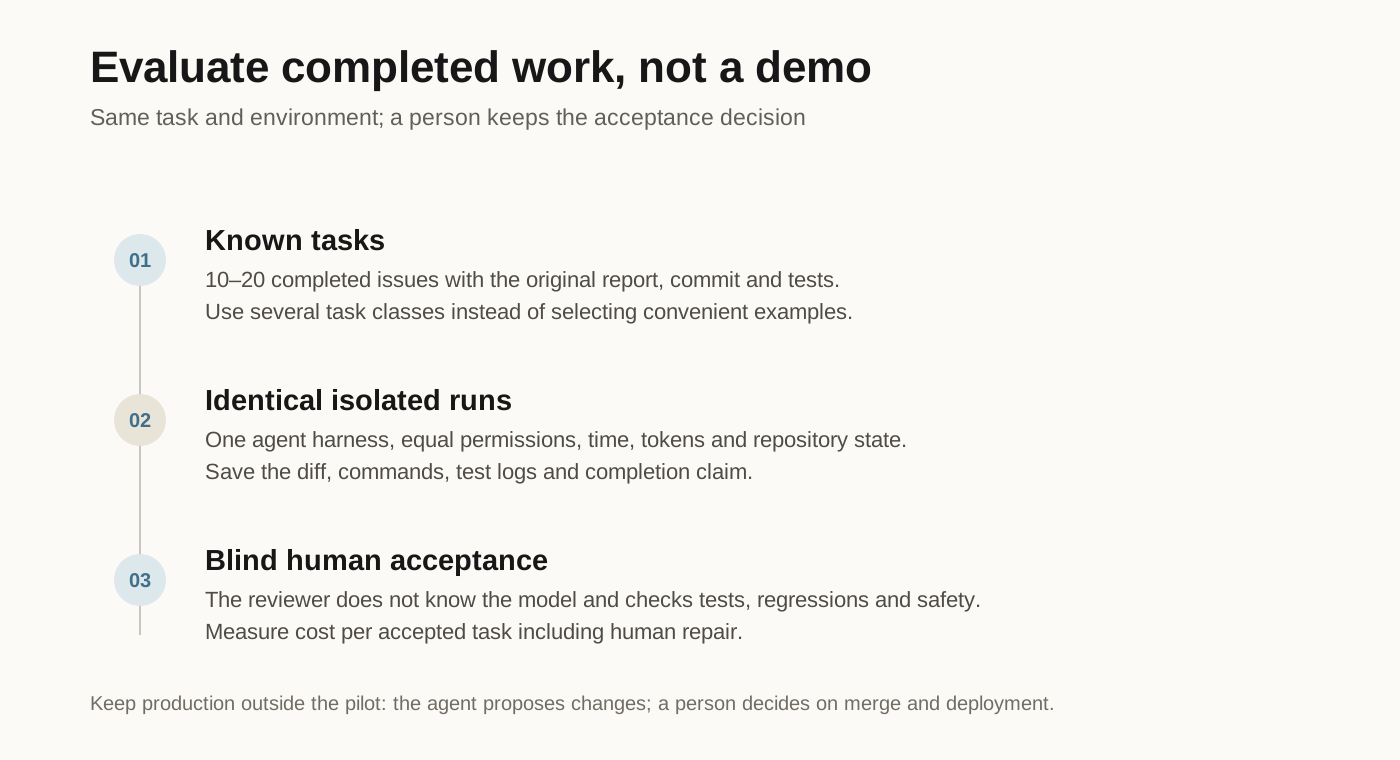
The practical response to this release is a short controlled pilot on previously solved tasks, where the original bug, accepted commit and tests are already known.
- Choose 10–20 completed tasks across local fixes, multi-file refactors, API compatibility, front-end work, tests and terminal diagnosis.
- Run GLM and the current frontier model in the same agent harness, with identical permissions, time, token budget and repository state.
- Save the complete diff, commands, test logs and the point at which the agent claimed completion.
- Use blind human review for tests, regressions, unnecessary changes, readability and security.
- Calculate the cost of an accepted task including retries and human repair. Keep production outside the pilot.
GLM-5.3 is already strong enough to deserve a place in that trial. The published numbers do not make it the uncontested coding-agent leader. Until external replication arrives, claims of superiority remain a hypothesis.
If the trial demonstrates value, the next stage is not unrestricted production access but a separate deployment boundary. Agent permissions, cost ceilings, action logs, failure monitoring and rollback rules should be defined before the model touches live work. That turns model selection into an engineering project: from evaluation on company tasks to reproducible deployment and controlled operation.
Sources and verification log
- Z.ai — GLM-5.3: Frontier Coding with Emergent Cyber Capabilities
- Z.ai — GLM-5 family documentation
- GLM-5 Team — From Vibe Coding to Agentic Engineering
- AI Agents GPT — review of benchmark verifiability
- VentureBeat — independent release analysis
- Emma Wilson — model and workflow value
- LocalLLaMA — early SlopCodeBench run
- Bigger Isn’t Always Better — automated code review preprint
- Axios — report on delayed weight publication