At the IJCAI–ECAI closing ceremony on Friday, organisers announced competition results, thanked volunteers and named the next host city. Three days earlier, Jan Peters had used the same stage to tell a different story: a robot broke after training in simulation because the algorithm had found a small physical error in the model and exploited it for “free energy.” Together, those scenes describe the conference better than the word “AI”: the organisation of an international research community at one end, a robot colliding with the real world at the other.
The official Video Recordings page lists 11 main-stage items from Bremen, held August 18–21: ceremonies, eight talks and the Robotics Panel. We reviewed all of them. This is not an account of the entire conference; parallel paper sessions, tutorials and workshops are not part of this recording archive.
At the opening ceremony, Francesca Toni introduced the programme and its organisers: IJCAI, EurAI, the University of Bremen, Bremen Research Alliance, the German Research Center for Artificial Intelligence and Gesellschaft für Informatik. The conference was part of Bremen’s Summer of AI, a city programme of public events from June through September.
The ceremony also makes the structure of the scientific meeting visible: main and special tracks, work from journals and sister conferences, early-career presentations, competitions and awards. David Parkes received the 2026 John McCarthy Award before later taking the same stage to discuss rules for societies of agents.
An agent is more than a chat with a model
Nick Jennings began by separating the current language-model wave from the older idea of an agent. In his account, an agent is a program that receives a task, keeps state, interacts with its environment and chooses later actions. A language model makes conversation with such a program easier, but it does not automatically add data retrieval, action execution or result checking. Jennings’s recording is built around that distinction.
His earlier examples do not resemble a modern chat demo. Beneath a Norwegian glacier, the ice moved, batteries ran down, and no one could simply walk in to replace a sensor’s power supply. Relaying a measurement through a neighbour preserved the network’s data but drained the intermediary sooner. The researchers had to encode a shared purpose rather than let every device protect itself: keep the glacier observable for as long as possible.
David Parkes carried the question into a society of agents. In his teaching game, one virtual postal carrier hides a nearby delivery so another carrier still makes the long trip and does more of the work. The first carrier benefits while the joint solution becomes worse. A second example has two agents report values for a hot dog; the winner pays the other agent’s report rather than its own. Parkes’s talk does not claim that this mechanism fits every market. It shows why information-sharing and pricing rules change participant behaviour.
The two talks end in the same less theatrical place. When several programs act for people or organisations, someone needs to see what they did, on what information, and whether the result can be checked. Parkes calls this observability and verifiability; Jennings frames it as safety and human control.
When people do not have one answer
Barbara Plank devoted her talk to the “myth of ground truth”: the habit of retaining one supposedly correct label for each dataset example. She showed images and texts that people judge differently: whether a face is smiling, a person’s occupation in a photograph, toxicity, or the meaning of a message. In these tasks, disagreement can describe what people actually saw differently rather than a failed annotation.
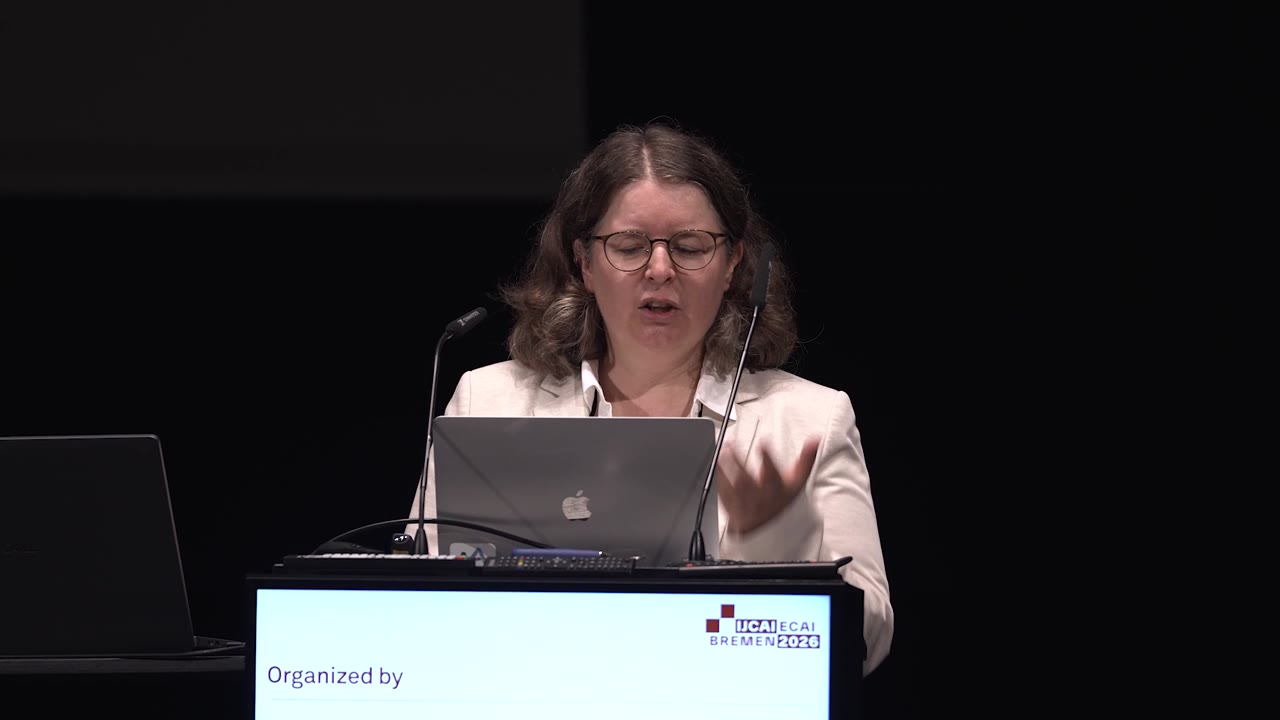
If only the majority answer remains, a model learns confidence where the people answering were not confident. Plank described approaches that preserve individual annotator answers, their confidence and the conditions under which they made the judgement. That does not mean every interpretation is equally correct. It means a system should not present a contested question as an uncontested fact.
She also examined language models used as synthetic survey respondents. The same supplied profile can produce different results depending on whether the model is asked to choose an option, write an answer, or expose its probabilities. Such an experiment can reveal something about the model and the prompt, but it does not, by itself, measure the views of real people.
One slide shows a photograph of a person and an apparently simple question about their occupation. The frame contains no biography, so an annotator must infer one from clothing, surroundings and prior assumptions. A smile or a sharp sentence produces the same problem: one person sees joy where another sees discomfort; one reads a joke where another reads abuse. Compressing those votes into one label removes more than noise. It removes the people who saw the scene differently.
Plank describes retaining the distribution of answers and information about the annotation process. Researchers can then distinguish near-unanimity from a result decided by a small margin. Evaluation changes too: instead of asking only whether the model matches the majority, it can ask whether the model represents uncertainty or becomes confident without evidence.
The synthetic-respondent experiment sharpens that point. If a model changes its stated position when the response format changes, it cannot simply stand in for a human survey. The result primarily measures the model’s sensitivity to instructions and to the way probabilities are read.
The world in a video, and the world where a robot acts
Jiajun Wu spoke about the “code of the physical world”: object geometry, materials, lighting, camera position, movement and causal structure. In his talk, computer vision has to recover more than an image’s appearance. It has to infer possible properties of the scene behind it. The internet supplies many images, videos and texts, but comparatively little data with those physical properties already annotated.
Wu’s group therefore combines neural models with more explicit three-dimensional and physical representations. In the work shown, a system can receive an image and a force applied to an object, then generate video of the object’s predicted response. When an audience member asked about quantitative evaluation, Wu said directly that the examples came from different research projects with different data and measurement methods. A persuasive video is not, on its own, that evaluation.
Jan Peters approached the gap between model and reality from robotics. His story of the broken robot was not a new conference accident but a lesson from earlier work: an algorithm exploited a small physical inconsistency in a simulator. In Peters’s talk, that becomes an argument for constraints during learning. A robot learning air hockey cannot first be allowed to strike in every direction and only later be penalised for a collision; a penalty does not repair a damaged machine.
A robot then steps onto a skateboard without cameras and holds its balance. For a few seconds it looks almost like a trick. Peters immediately brings the audience back to the conditions: the machine has an approximate initial belief about the board, can sense its own joints, and practised the movement in simulation. The moment loses none of its interest; the apparent magic simply becomes an engineering task with stated boundaries.
Wu begins with the inverse relationship between graphics and vision. Graphics starts with geometry, materials, lighting and a camera, then renders an image. Vision sees the image and tries to recover possible scene parameters. Several combinations can produce the same frame, so a single answer is often unjustified.
His group therefore predicts distributions over possible properties and uses synthetic scenes where the underlying parameters are known. Real experiments require other evidence, including measurements and multi-camera capture. Asked about the term world model, Wu notes that it has no single settled meaning: it may refer to an explicit 3D representation, a video predictor or a model of hidden state.
Peters places constraints before the first dangerous move. In air hockey, the allowed region prevents the arm from striking itself or nearby equipment during exploration. This is not a penalty after a mistake but a prohibition on part of the action space. A simulator can be restarted; a damaged actuator cannot.
The same argument shapes transfer between robots. A fully hand-built physical model remains inaccurate, while unconstrained learning requires too many risky trials. Peters argues for a middle ground in which geometry, dynamics and the body shape learning, while data still refines the actual movement.
Rules in code and representations in images
Luciano Serafini explained a neuro-symbolic approach: neural networks work with data and approximate scores, while logical formulas state explicit relations and constraints. His group develops Structural Logic Tensor Networks, a system that translates logical expressions into tensor computations. In the recording, he uses video as an example: if a system says that a tomato is being cut, a rule connects that action to the presence of both a tomato and a knife.
Such a rule is evaluated by a degree of satisfaction, not an absolute yes or no. Serafini also pauses over words such as “for all.” In classical logic, that means every possible object; in training, a system works over a finite set of data. It needs a way to aggregate scores across that set, and the choice changes how the system learns.
Tinne Tuytelaars addressed a neighbouring problem: visual representations. A good representation, she argued, retains the information useful for a task and discards noise. Her review covered contrastive learning, image masking, and work that finds correspondences across different images while using text to help distinguish objects. Larger models have not made the question disappear: later behaviour depends on what an internal representation has preserved and what it has lost.
Structural Logic Tensor Networks turn symbols and relations into tensor expressions that can be evaluated alongside a neural network. A rule connecting tomato cutting to the presence of a tomato and a knife does not replace visual recognition; it couples several predictions. Training increases satisfaction of both observed facts and stated rules.
The difficult part appears with “for all.” Taking the minimum matches the intuition that a universal statement is only as strong as its worst case, but then one bad example can dominate the gradient. Smoother aggregators spread influence across examples while moving away from the classical meaning of universality. Serafini presents this as a modelling choice, not a solved implementation detail.
Tuytelaars separates several forms of representation learning without complete manual labels. Contrastive methods draw related views together and unrelated views apart; non-contrastive methods avoid explicit negative pairs; masking asks a model to reconstruct hidden parts. Each method encodes a different answer to what information should survive.
In her group’s correspondence work, points and object parts are matched across separate images. Cycle consistency acts as a check: if a journey from one image to another and back does not return to the starting region, the pair is not treated as a reliable signal. Another project uses text to connect visual clusters with concepts in captions, while remaining limited by what those captions contain.
Robotics and access to research
On the Robotics Panel, participants pushed back against the idea that one very large vision-language-action model will settle robotics by itself. Such a model takes an image and text, then produces an action command. They discussed power draw, computation on the device, hardware, models of people and the consequences of actions. Their philosophical question — does a robot “understand” what it does? — became a practical one: can a system be trusted if it cannot represent the consequences of its actions?
The last main talk, IJCAI In the World, was not about a new architecture. Georgina Curto spoke about who gets the opportunity to do AI research: funding, visas, infrastructure, conflict, data access and local problems. Her examples included work in Africa, online teaching for girls in Afghanistan, and researchers participating from countries affected by conflict.
The talk matters beside the discussions of large models and expensive equipment. A conference can debate safer robots and better rules for agents while access to laboratories, data and venues remains uneven. Curto did not offer a universal recipe; she described small programmes, partnerships and constraints that cannot be removed by a single online call.
The panel repeatedly returns to energy. A large model may impress in a laboratory demonstration, while a mobile or domestic robot remains constrained by battery capacity, heat and onboard computation. Moving everything to the cloud is not neutral either: it introduces delay, network dependence and questions about what data leaves the device.
Medical and domestic uses make the debate over understanding less philosophical. A plausible motion command is insufficient when a robot operates near a person. The system must account for position, acceptable force, hardware condition and the consequences of error. Participants therefore discuss learning alongside explicit models and engineering limits.
Curto shifts the question from what a system can do to whether a researcher can enter this room at all. A good paper is insufficient: participation also requires compute, data, travel money and a visa. A small school or online programme can open the first door where no large laboratory exists, but more doors remain behind it. The hope of holding a conference in Africa therefore arrives with ordinary, stubborn questions about venues, transport and who will pay.
From Bremen to Barcelona
The opening and closing ceremony frame these conversations with awards, competitions, submission statistics and plans for the next conference in Barcelona. The substantive thread through the recordings is different. An autonomous program is not only a model; it needs rules, data, observability and limits on action. A robot is not only a movement demo; it needs conditions under which that movement does not harm a machine or a person.
Across the 11 recordings, “agent” and “world model” lead more often to concrete questions than to promises of general intelligence: who reports information, what a monitor can see, which data cannot be compressed into one label, and what happens when a simulation meets physical equipment.
The closing ceremony first announces competition results. One of the tasks shown concerns detecting forged identity documents. Programme chairs then discuss submissions, accepted papers and participating countries, while organisers consider how fees from non-primary papers might support the next conference.
The international association of national AI organisations admits a group from North Macedonia and reports that it now includes 25 organisations. The next IJCAI is planned for Barcelona; the closing names general chair Carles Sierra, programme chairs Ronny Stern and Luis Travé, and the local team.
The ceremony thus returns the discussion from models to institutions. Rules do not govern only Parkes’s virtual postal carriers: a conference also distributes attention, money, travel and the chance to be heard. Curto’s talk makes that connection explicit, while the Barcelona plans show where it will next be tested.