On August 25, Cisco announced an expansion of Secure AI Factory with NVIDIA to include Supermicro servers and end-to-end liquid cooling for compute and networking equipment. Cisco plans to add these systems to its range in October 2026.
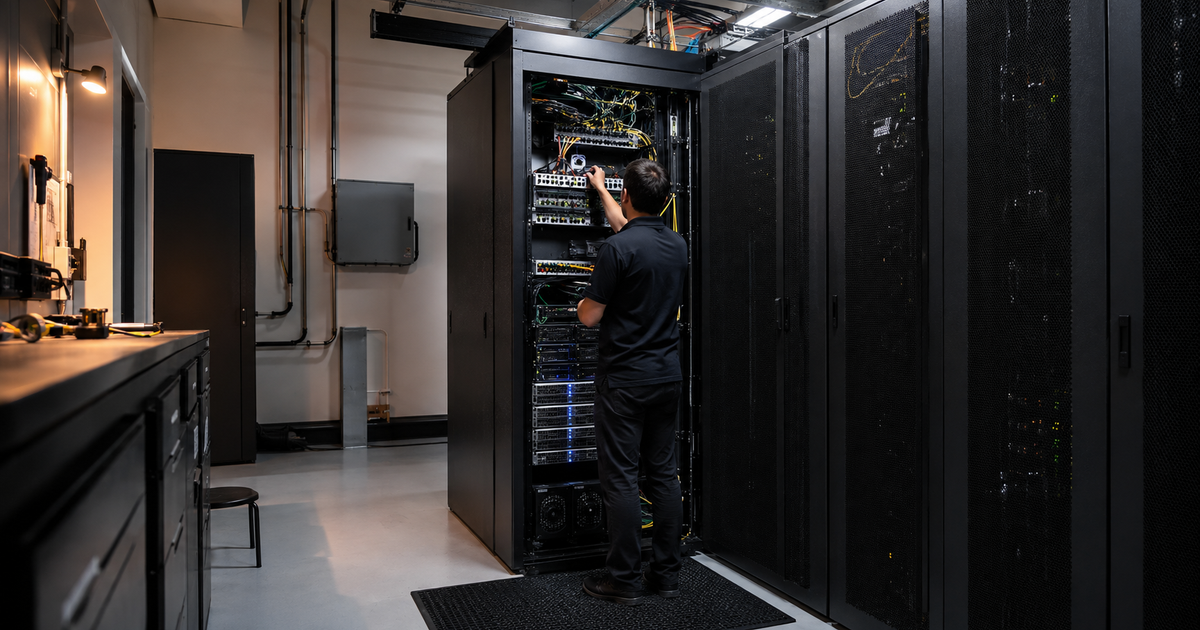
A rack is a cabinet holding servers, network devices and power-distribution equipment. In an AI system, several servers can jointly train a model or process requests. Packing more powerful components into one cabinet increases the heat that must be removed from a small area.
What 200 kW looks like
SiliconANGLE’s analysis discusses dense configurations consuming more than 200 kW per rack. Actual power depends on equipment and load; this is not a general specification for Cisco’s entire range.
For scale, take exactly 200 kW: the power drawn by one hundred 2 kW kettles switched on together. Maintaining that load around the clock for 30 days consumes 144 MWh. This is a calculation for a specified constant load, excluding external cooling and other facility systems.
Almost all energy consumed by computing equipment becomes heat. A suitable power cable is therefore insufficient: heat must be removed continuously. The site’s available electrical supply and cooling capacity determine whether it can accommodate the configuration at all.
Where heat goes from the liquid loop
In an air-cooled system, fans move air across hot components. As density rises, supplying enough cool air to each component and removing the heated air becomes harder. Liquid can collect heat directly beside the component.
A metal plate containing coolant channels sits against the processor or another hot part. A pump moves the liquid, and a heat exchanger transfers the collected heat onward to the site’s cooling system. The coolant and external-loop design depend on the project.
The rack’s internal loop therefore does not replace the building’s heat-removal system. The room may still need air cooling for components outside the liquid loop.
Why Cisco also cools the network
When a model runs across several servers, they repeatedly exchange intermediate data. Switches, the devices connecting servers into a network, also consume electricity and produce heat. Their cooling becomes part of the whole-rack design.
Cisco’s announcement FAQ describes a coordinated approach to compute, networking, power and liquid cooling. Supermicro servers and network equipment are selected as parts of one system.
Validation after assembly
Alongside the equipment, Cisco announced Validated Infrastructure Services to check installed infrastructure. Specialists are intended to confirm that a system matches its design and NVIDIA’s reference architecture. The company also plans to use its large AI lab to develop tools and software for that validation.
Cisco’s shared monitoring will include compute, network-card, optics and network metrics. An engineer will be able to relate them to the state of a running job and investigate where a delay occurs. When a model is spread across many accelerators, this supports analysis of the installation as a whole rather than individual servers alone.