On August 25, NVIDIA announced Jetson Orin Nano 2, a compact module for robots, drones and vision systems. NVIDIA specifies 78 TOPS, 8GB of memory and an eight-core Arm CPU; the module and developer kit are expected in the first half of 2027.
The headline number needs interpretation. TOPS is a theoretical count of trillions of operations per second at a defined precision. It does not say how many frames a particular model will process, whether the model fits in memory or how quickly a machine reacts after receiving a camera frame.
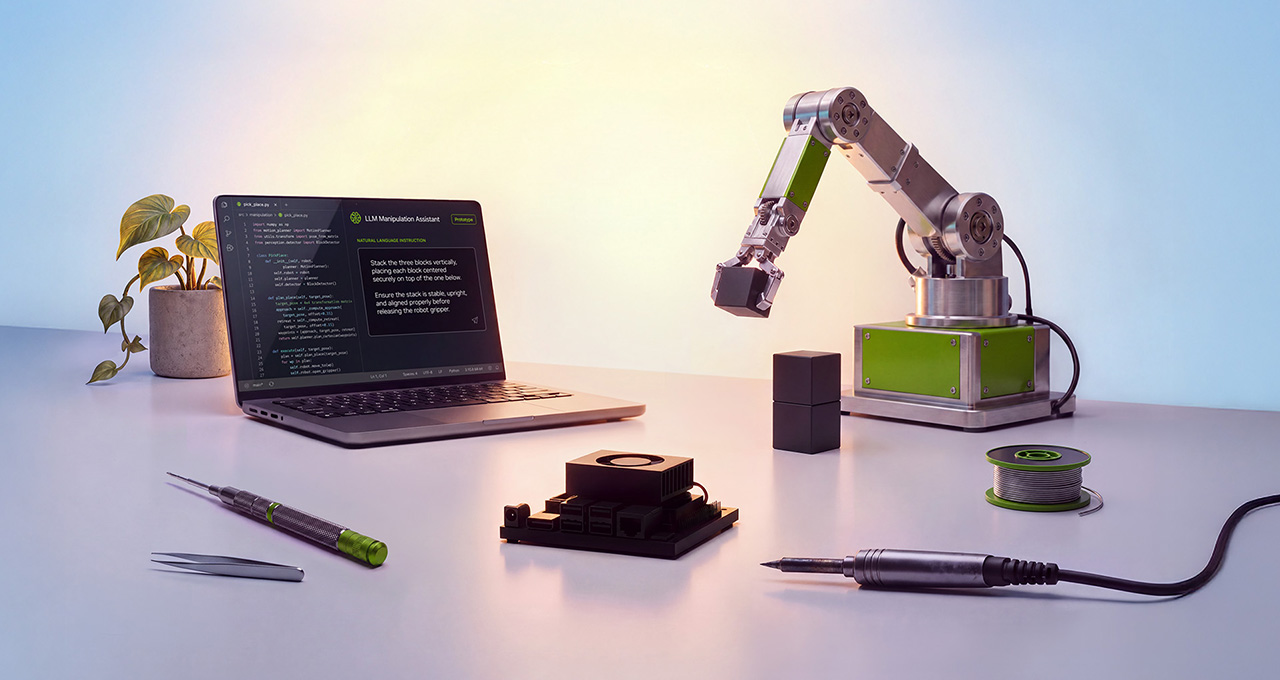
A module and developer kit are also different products. The module is the compute board integrated into a device; a kit adds carrier board, connectors and a prototyping environment. Price and configuration are not yet stated, so the announcement cannot support a production-robot cost estimate.
“Twice as fast” does not mean twice the TOPS
The preceding Jetson Orin Nano Super is rated at 67 TOPS, so 78 TOPS is roughly a 16 percent increase, not 100 percent. NVIDIA attributes the claimed doubling of inference performance to improved Tensor Cores and higher memory bandwidth. It is a vendor claim about model execution, not arithmetic between two peak ratings.
Specialist publication Notebookcheck also noted that detailed specifications were sparse at announcement. Until developer kits arrive, there are no like-for-like results for identical models and power limits, per-layer latency or sustained performance under long loads.
| Characteristic | Orin Nano Super | Orin Nano 2 | Still unknown |
|---|---|---|---|
| Peak AI rating | 67 INT8 TOPS | 78 TOPS | Whether precision and counting conditions match every comparison. |
| CPU | 6-core Arm Cortex-A78AE | 8-core Arm | Architecture, clocks and sustained performance. |
| Memory | 8GB LPDDR5, 102GB/s | 8GB; NVIDIA cites higher bandwidth | Exact bandwidth and memory available to applications. |
| Availability | Shipping; earlier kits gained Super mode by software update | Expected in the first half of 2027 | Price, regional channels and production configurations. |
The predecessor figures come from NVIDIA’s technical account of Super mode. It provides useful history: the 2024 rise from 40 to 67 TOPS came from software and higher clocks on the same hardware. Future Nano 2 comparisons will likewise depend on JetPack and library versions, not silicon alone.
One rating hides several kinds of computation
TOPS usually describes low-precision integer operations suited to neural-network inference. A language model, image segmenter and mapping algorithm use different combinations of GPU, Tensor Cores, CPU and memory. Two applications with similar operation counts can bottleneck in different parts of the system.
A camera pipeline depends on decoding, frame copies and sensor-to-decision latency. A language model depends on memory bandwidth, context size and sequential token generation. A robot also runs planning, motor control and safety rules. A peak rating does not add these delays into a finished response.
A fair test therefore records more than frames per second: median and worst-case latency, sustained power, temperature after half an hour, dropped frames and accuracy after quantization. Together they show whether a device is faster at the actual job.
The 15W mode may matter more to the enclosure
NVIDIA says Nano 2 can match its predecessor’s performance in a 15W mode while using 40 percent less power. The wording concerns a selected performance level; it does not promise a 40 percent reduction for every application.
For a mobile robot, the claim could still matter more than peak TOPS. Less heat can mean a smaller heatsink, quieter cooling, longer battery life or more power for cameras and actuators. The test unit must be the full system: module, storage, sensors, power conversion and cooling.
The energy gain can be spent differently. A fixed camera may retain its heatsink for more thermal margin; a drone may reduce cooling mass or keep it for steadier clocks; a home robot can give the saved power to motors. One improvement does not produce one outcome across devices.
The same shape protects some engineering work
The module retains its predecessor’s compact form factor. NVIDIA partners are preparing carrier boards, systems and reference solutions. That reduces risk for teams designing an enclosure and electronics today because part of the mechanical and board work may survive a module upgrade.
Physical compatibility is not software compatibility. A replacement still depends on exact connectors, JetPack support, camera drivers, power modes and component life cycle. A partner list demonstrates ecosystem activity; it does not establish that a specific configuration can be ordered or delivered in every market.

The Aetina image is useful because it marks the boundary between module and product. An enclosure adds power, networking, cooling, mounting and a supplier responsible for compatibility. A robot buyer rarely needs a bare module; they need a validated system or a carrier board with a support life cycle.
Eight gigabytes is a hard boundary
NVIDIA points to language and vision-language models optimized for edge inference. Eight gigabytes of shared memory requires compact or quantized models and careful allocation between the network, video streams and operating system. Long context or several cameras consume the margin quickly.
Nano 2 is therefore better evaluated as a node for a defined task — defect detection, navigation, object recognition or constrained dialogue — than as a tiny general-purpose server. Local processing can reduce latency and network dependence, but it does not remove model updates, device security or failure monitoring.
Eight gigabytes also separates a lab demonstration from a deployable system. A model may run alone, then slow down when two cameras, logging and a user interface are enabled. Memory margin must cover spikes, updates and safe recovery, not only the average case.
Quantization reduces memory use but can change quality. A defect detector must be rechecked for rare missed damage, a language assistant for instruction adherence and navigation for unusual obstacles. Memory savings count only after the target task is validated again.
Local inference changes responsibility as well as latency
When frames stay off the cloud, a device can work through weak connectivity and avoid per-request charges. That matters in factories, transport and field robots. Locality also moves maintenance to the owner: system images, security patches, storage health and model updates now belong on every device.
A fleet of one hundred modules needs signed updates, staged rollout, temperature and model-version monitoring, and rollback to a known image. Without that machinery, a local advantage becomes one hundred computers in different states with unknown inference quality.
Procurement adds another boundary in markets where regional sales are uncertain. NVIDIA announced global timing but not price, channel or support for every configuration. Buyers must distinguish the available Orin Nano Super from the future Nano 2 and verify contract, hardware provenance, warranty and continuing JetPack access.
Design now; procure after measurement
Until the first half of 2027, the module is a roadmap item. A team can prototype on the available Orin Nano Super, record workload, memory, latency, temperature and power, then repeat the same tests on Nano 2. This separates architectural gains from software improvements.
A production device also needs a carrier board, cameras, storage, power, enclosure, cooling, reproducible system image, remote update and safe rollback. Its specification should come from a measured workload, not the largest number on a product page.
- Fix one model version, input set and latency target on the available Orin Nano Super.
- Measure full-system power, temperature, memory and quality under sustained load rather than a short run.
- Preserve the container or system image, logs and inputs so Nano 2 can be tested without changing the method.
- Before volume procurement, verify carrier board, cameras, JetPack, warranty, supply channel and fleet updates.
Jetson Orin Nano 2 makes a credible promise: more useful work in the same space with less heat. Yet the most important figure in the announcement is not 78 TOPS but the first half of 2027. Until independent hardware tests arrive, the platform is a good reason to prepare a compatible prototype, not to commit a production design to a module that does not yet ship.